


Big brands can outspend you. They can’t out-relevance you. That’s the real opportunity in PPC (pay-per-click) advertising for a small business: a level playing field where a well-targeted £500-a-month campaign can outperform a competitor’s £20,000-a-month account, because the auction rewards how well your ad matches what someone is actually searching for, not just the size of the bid behind it. This guide covers the full strategy: what PPC is, why it suits small budgets specifically, and the tactics that separate a campaign that competes from one that quietly burns money.
Quick answer: PPC (pay-per-click) advertising lets small businesses appear in search results and pay only when someone clicks. It works well for small businesses because cost is controlled entirely by the advertiser, targeting can be narrowed to a specific area and audience, and Google’s auction rewards relevance and Quality Score as much as budget size. The strategies that matter most are: targeting high-intent, long-tail keywords; writing tightly themed ad groups; sending traffic to dedicated landing pages; maintaining a negative keyword list; and tracking cost per acquisition rather than clicks alone.
What Is PPC Advertising?
PPC, or pay-per-click advertising, is a digital advertising model where you pay a fee only when someone clicks your ad, rather than paying a flat rate for a placement regardless of results. It’s most commonly associated with Google Ads, but the model also covers Microsoft (Bing) Ads and paid social platforms like Meta and LinkedIn. For most small UK businesses, Google Search is the natural starting point. It captures people who are actively typing in what they need, rather than passively scrolling and hoping to be interrupted by something relevant.
Why PPC Works Especially Well for Small Businesses
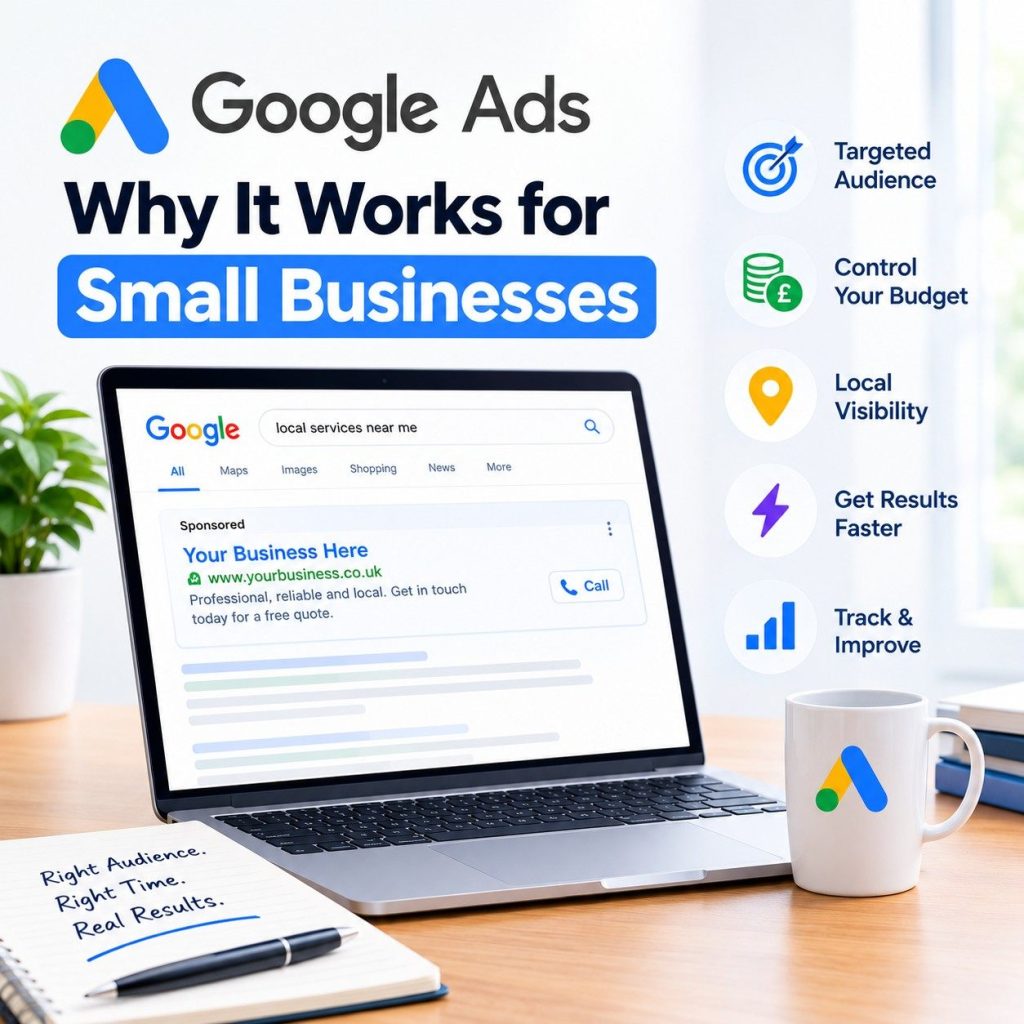
- Full budget control: you set a daily or monthly cap and can pause spending instantly if something isn’t working.
- Relevance beats raw budget: Google Ads Quality Score means a highly relevant, well-written small business ad can rank above a generic big-brand ad, often at a lower cost per click.
- Precise local targeting: you can restrict ads to a specific town, postcode radius, or region, so you’re never paying to compete nationally when your customers are local.
- Immediate visibility: unlike SEO, which typically takes three to six months to build momentum, a PPC campaign can generate clicks within hours of going live.
- Transparent, real-time data: every click, cost, and conversion is measurable, so decisions are based on actual numbers rather than guesswork.
The PPC Challenges Small Businesses Actually Face
The upside is real, but so are the pitfalls, and most of them come down to three root causes.
Competing against bigger advertising budgets
Larger competitors can afford to bid aggressively on broad, high-volume keywords. Chasing them on the same generic terms usually burns a small daily budget with little to show for it. The better approach is targeting the more specific searches bigger brands don’t bother with, covered below.
Limited time and in-house expertise
Keyword research, ad testing, and weekly account maintenance take real time, and most small business owners are already stretched thin running the business itself. This is often where the decision between doing it yourself and bringing in help starts to matter (more on that later in this guide).
Earning trust in a single glance
When your ad appears next to a household name, your ad copy has a split second to convince someone your business is worth clicking. Specific, credible claims (a real guarantee, a clear price, a genuine local presence) do more work here than generic brand messaging.
PPC vs SEO: Which Should a Small Business Prioritise First?
This is less an either/or decision than it looks. PPC delivers traffic almost immediately but stops the moment you stop paying. SEO takes months to build but keeps working with no per-click cost once it ranks. As a rough guide, a business with tight local competition and limited existing visibility often gets faster traction from PPC first, while a business with more time to invest and less immediate pressure for leads can build SEO in parallel. Most established small businesses eventually run both, using PPC data on which keywords actually convert to guide their longer-term SEO content decisions.
Building Your Small Business PPC Strategy
1. Start with a clear goal and a narrow focus
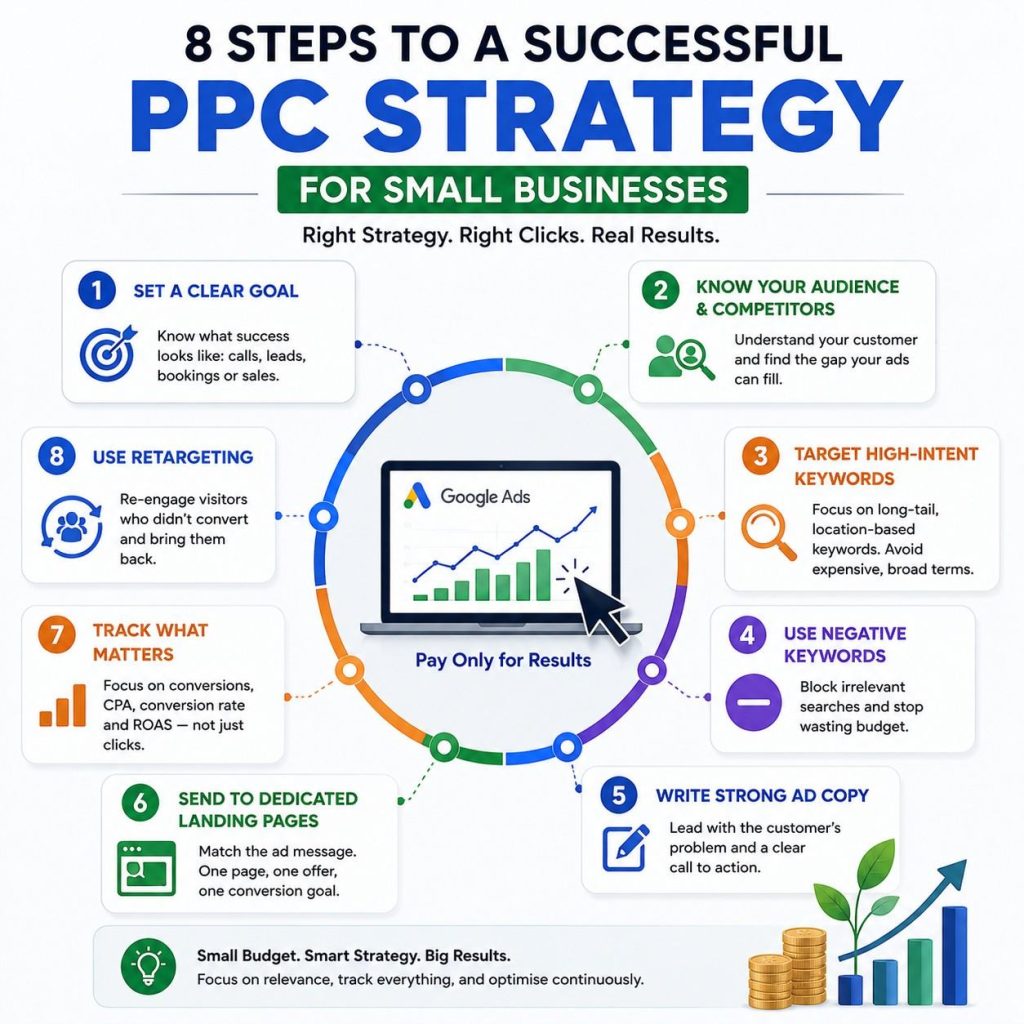
Define exactly what a conversion means for your business before you touch keyword research: a phone call, a form submission, a booking, a purchase. Every later decision, from which keywords to what the ad says to what the landing page shows, should point at that one goal. Launch one focused campaign first rather than spreading a small budget across several services or locations at once. A concentrated test gives you a clear read on what’s working within weeks, not months.
2. Understand your audience and check what competitors are doing
Sketch a simple picture of your ideal customer: what they need, how urgently, and what would make them choose you over the next search result. Then look at what competitors’ ads and landing pages actually say. The goal isn’t to copy them, it’s to spot the gap, whether that’s faster response times, clearer pricing, or a stronger guarantee, that becomes your own ad’s main argument.
3. Target high-intent, long-tail keywords
This is one of the highest-leverage moves for a small budget. Big brands typically bid on broad, expensive category terms. A small business usually gets far better value further down the search, on longer, more specific phrases that signal someone is close to a decision.
- Broad and expensive: “accounting software” high competition, unclear intent, costly per click.
- Long-tail and high-intent: “affordable bookkeeping service for small cafes” lower competition, lower cost per click, and the searcher is much closer to buying.
- A location modifier sharpens intent further: “emergency plumber in London” or “wedding photographer pricing in Leeds” convert at a noticeably higher rate than the unmodified term.
Use a keyword research tool to find these lower-volume, high-intent phrases specifically. They typically carry a lower cost per click because fewer advertisers bother targeting them, which stretches a limited budget further.
4. Build a negative keyword list from day one
Negative keywords tell Google which searches to exclude your ads from, and they’re one of the fastest ways to stop a small budget leaking away. Add obvious exclusions before launch, such as “jobs,” “salary,” “free,” “course,” and “DIY,” then review your Search Terms report weekly for the first month and add anything irrelevant you spot. Accounts that skip this step routinely waste a real share of their budget on clicks that were never going to convert.
5. Write ad copy that leads with the customer’s problem
Ad copy should answer three things fast: what you offer, why it matters, and what to do next. Lead with the customer’s need rather than your company history, include a specific, credible detail such as a guarantee, a real price, or a local marker like “serving Leeds since 2015,” and close with a direct call to action such as “Get a Free Quote,” “Book Your Consultation,” or “Claim 10% Off Today.” Write at least three to four headline variations per ad group using Responsive Search Ads, and let the data decide which combination performs best, not personal preference.
6. Send every click to a dedicated landing page
Sending traffic to your homepage is one of the most common ways small businesses quietly waste PPC budget. A dedicated landing page that matches the ad’s exact message, same headline, same offer, same service, converts at a noticeably higher rate, and it also improves Quality Score, which can lower your cost per click. At minimum, the page should load quickly, work well on mobile, include a testimonial or review, and offer one clear action: a form, a booking flow, or a prominent phone number.
7. Track the metrics that actually reflect business results
Clicks and impressions look encouraging but don’t pay the bills. The metrics worth watching closely are cost per acquisition (CPA), what it costs to convert one lead; conversion rate, the share of clicks that convert; and, once you have enough data, return on ad spend (ROAS). Set up conversion tracking through Google Ads and Google Analytics before launch, covering calls, form fills, and bookings. Without this, every later optimisation decision is a guess rather than a choice backed by data.
8. Use retargeting to recover the visitors who didn’t convert first time
Most visitors won’t convert on their first visit. Some studies suggest it can take several visits before someone finally calls, books, or buys. Remarketing lets you show ads specifically to people who’ve already visited your site (or a specific service page) without converting, and that audience typically converts at a lower cost than cold traffic, simply because they already know who you are.
What a Realistic PPC Budget Looks Like for a Small Business
This deserves a full breakdown of its own, covered in How Much Does Google Ads Cost in the UK?, which has real 2026 UK pricing by industry. As a general guide, most small businesses see a fair first test on £500–£1,500 a month in ad spend, adjusting up or down as real conversion data comes in. There’s no universal minimum, but budgets much below this rarely generate enough clicks and conversions for the algorithm to optimise properly.
Common PPC Mistakes Small Businesses Make
- Setting a campaign live and not checking back for weeks PPC needs regular attention, ideally reviewed at least weekly in the first month.
- Relying entirely on broad match keywords with no negative keyword list, which invites irrelevant clicks.
- Sending every ad to the homepage instead of a dedicated landing page built around the offer.
- Judging performance after a few days rather than giving the campaign two to four weeks to gather real data.
- Spreading a small budget thinly across too many campaigns, services, or locations at once instead of starting focused.
- Skipping conversion tracking, which turns every later decision into a guess instead of a data-backed choice.
How Newton Byte Helps Small UK Businesses Get More From PPC
Newton Byte works with small and growing UK businesses on Search Engine Marketing, building focused PPC campaigns around high-intent keywords, dedicated landing pages, and proper conversion tracking from day one the fundamentals this guide covers, done for you. If you’d like a second opinion on an existing campaign or want one built from scratch, get in touch with our team or explore our Search Engine Marketing services to see how we structure PPC for small businesses.
Can AI Help Manage a Small Business PPC Campaign?
Google Ads’ built-in automated bidding (Smart Bidding options such as Target CPA or Maximise Conversions) and AI-assisted ad testing can genuinely help a small business get more from a limited budget, but they work best once there’s enough conversion data for the system to learn from, typically 15–30 conversions in the past 30 days. Used too early, on an account with little data, automated bidding can behave unpredictably. AI is a useful accelerator for testing and optimisation. It isn’t a replacement for a clear goal, accurate tracking, and a person checking whether the results actually match what the business needs.
Should You Run PPC Yourself, or Bring in Help?
A very small, single-campaign account is realistic to manage in-house if you’re willing to invest a few hours a week, particularly on conversion tracking and negative keywords, the two areas that cause the most wasted spend when neglected. Once you’re running multiple campaigns, a serious monthly budget, or operating in a competitive industry where mistakes are expensive, bringing in a specialist typically pays for itself. If you do look for help, prioritise proven small business experience, plain-English reporting, and a clear focus on results over raw click volume. The full breakdown of typical UK pricing and what a fair fee should include is covered in Google Ads Management Fees UK Explained.
Frequently Asked Questions
Is PPC worth it for a small business?
Yes, for most small businesses. PPC reaches people actively searching for what you offer, and Google’s auction rewards relevance and Quality Score, not just budget size. It works best when paired with accurate conversion tracking and a genuinely narrow, well-targeted keyword strategy.
How much should a small business spend on PPC?
There’s no fixed minimum, but most UK small businesses see a fair first test at £500–£1,500 a month in ad spend, adjusted based on real cost-per-lead data after the first few weeks.
How long does PPC take to generate leads?
Traffic and clicks can appear within hours of launch, and enquiries often follow within the first day or two. Reliable, cost-effective performance typically takes two to four weeks of consistent data and optimisation.
What’s a good PPC conversion rate for a small business?
Averages vary by industry, but 3–5% is a reasonable general benchmark, while tightly targeted local service campaigns often see 10% or higher.
What are negative keywords, and why do they matter?
Negative keywords stop your ads showing for searches that aren’t relevant to what you offer, for example excluding “jobs” or “free” from a paid service campaign. They’re one of the fastest ways to stop a limited budget being wasted on clicks that were never going to convert.
Should a small business choose PPC or SEO?
Most benefit from both over time. PPC delivers faster visibility and is easier to switch off or scale, while SEO builds longer-term traffic that doesn’t carry a per-click cost. Many small businesses start with PPC to generate quick leads and data, then use that data to inform an SEO content strategy.
Final Thoughts
A small budget isn’t the disadvantage it looks like in PPC advertising. An unfocused strategy is. The businesses that consistently compete with much bigger advertisers are the ones targeting specific, high-intent searches, protecting their budget with disciplined negative keywords, sending traffic to landing pages built for conversion, and reviewing real performance data every week rather than setting a campaign live and hoping. Get those fundamentals right, and a modest monthly budget can realistically outperform a competitor spending many times more.
For the full picture of running Google Ads in the UK, including costs, campaign types, and management fees, see the main pillar guide, Google Ads UK The Complete Guide for Small and Growing Businesses.