

If you’ve typed “google ads uk” into a search bar, you’re probably trying to answer one of three questions: what does it actually cost, is it worth it for a business like mine, and how do I stop wasting money on it. This guide answers all three with real 2026 UK pricing, honest trade-offs, and a step-by-step path from zero to a working campaign.
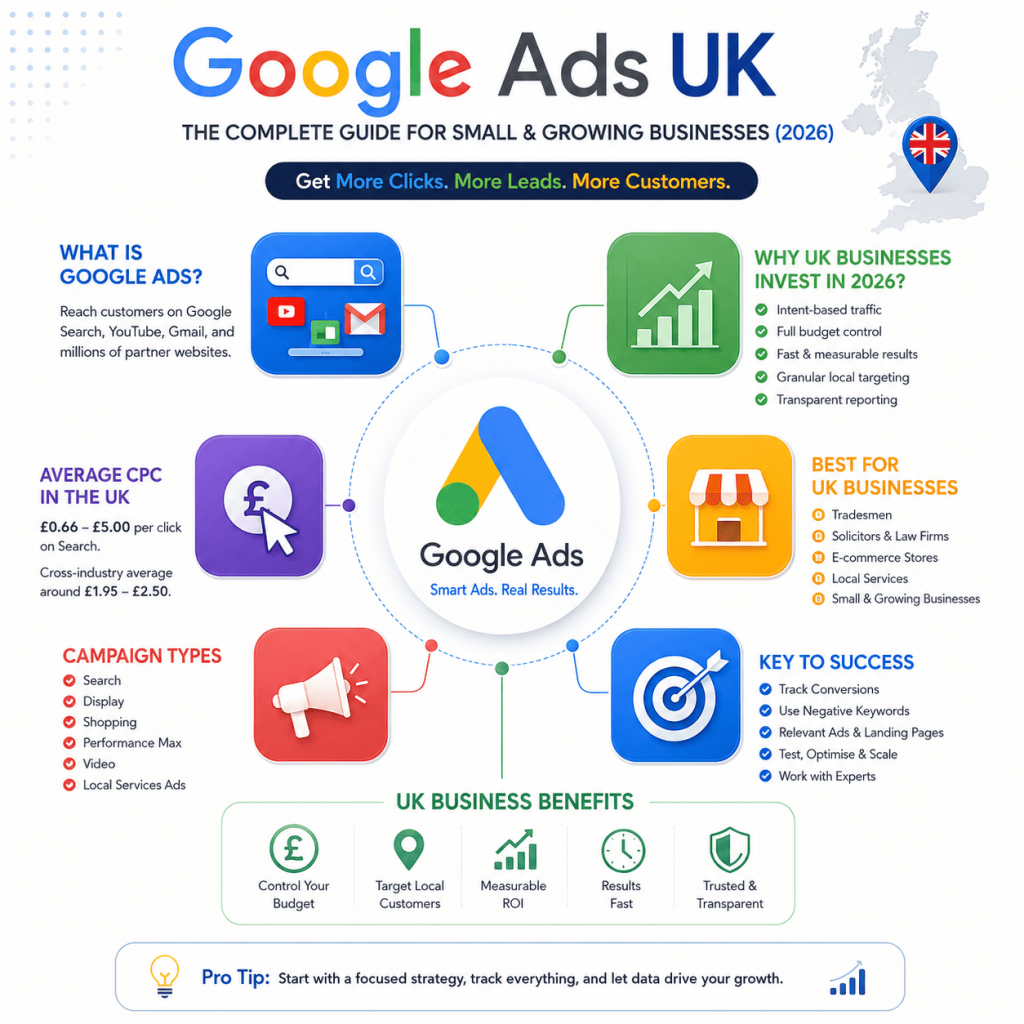
Quick answer: Google Ads is Google’s pay-per-click (PPC) advertising platform. In the UK, businesses typically pay between £0.66 and £5.00 per click on Search, with a cross-industry average sitting around £1.95–£2.50. Most small UK businesses see a fair test of performance on £600–£1,500 a month in ad spend, run either in-house or through a specialist PPC agency charging roughly £300–£2,000 a month in management fees.
What Is Google Ads and How Does It Work in the UK?
Google Ads Search Engine Marketing is the advertising system that places your business at the top of Google’s search results, on YouTube, on Gmail, and across millions of partner websites (the Google Display Network). Instead of paying a flat fee, most UK advertisers use pay-per-click (PPC) bidding: you only pay when someone actually clicks your ad.
Every time someone searches, Google runs a real-time auction between every advertiser bidding on that keyword. Who wins and what they pay depends on three things:
- Your bid: the maximum you’re willing to pay for a click.
- Your Quality Score: Google’s 1–10 rating of how relevant your ad and landing page are to the search.
- Ad Rank: a combination of bid, Quality Score, and expected impact of your ad extensions/assets.
This is why two UK businesses bidding on the same keyword can pay very different prices. A well-optimised, highly relevant account with strong Quality Scores can genuinely pay less per click than a competitor with a bigger budget but apoorly matched landing page.
Why UK Businesses Are Investing in Google Ads in 2026
Search advertising remains the backbone of UK digital ad spend. Search now accounts for the largest single share of digital advertising investment in the UK, and total search ad spend has continued to climb year-on-year as more small and mid-sized businesses move budget from print, local directories, and traditional advertising into measurable, trackable channels.
The appeal for UK businesses is straightforward:
- Intent-based traffic : you reach people actively searching for what you sell, not passively scrolling.
- Full budget control: Daily and monthly spend caps, pausable at any time.
- Fast, measurable results: Unlike SEO, which typically takes 3–6 months to build momentum, Google Ads can generate qualified traffic within hours of launch.
- Granular local targeting: Down to a postcode radius, useful for tradesmen, clinics, solicitors, and other location-bound services.
- Transparent reporting: Every click, cost, and conversion is trackable back to pounds and pence.
How Much Does Google Ads Cost in the UK?
This is the single most-searched question on the topic, so it deserves a proper cluster article of its own How Much Does Google Ads Cost in the UK?. Here’s the honest, sourced overview.
Google doesn’t publish official average CPC (cost-per-click) figures, so any number you see including the ones below is an industry estimate drawn from aggregated agency and third-party benchmark data, not a Google-confirmed figure. Treat these as a planning guide, not a guarantee.
| Industry | Typical UK CPC (Search) | Notes |
| Cross-industry average | £1.95 – £2.50 | Wide variation by location and competition |
| Legal services | £4.00 – £12.00+ | Highest-cost UK vertical; London runs higher still |
| Financial services / insurance | £4.00 – £10.00 | High customer lifetime value justifies the spend |
| Tradesmen (plumbers, electricians, roofers) | £1.50 – £3.50 | Local Services Ads often cheaper per lead than Search |
| E-commerce / retail | £0.60 – £2.00 | Shopping Ads typically undercut standard Search CPC |
| Charity / non-profit | £0.85 – £2.00 | Google Ad Grants can offset paid spend entirely |
A few consistent patterns across sources are worth remembering:
- London and other major UK cities typically run 15–30% above the national average for the same keyword.
- CPCs have risen for several consecutive years as more advertisers enter the auction budget for gradual increases, not flat pricing.
- Cost per click matters less than cost per acquisition (CPA). A £5 click that converts at 8% can be cheaper, per customer, than a £1 click that converts at 0.5%.
As a starting point, most UK small businesses need a minimum of roughly £600–£900 a month in ad spend before a campaign generates enough data (clicks and conversions) to optimise properly. Below that, Google’s algorithms simply don’t have enough signal to learn from.
Google Ads Management Fees UK Explained
Ad spend and management fees are two separate costs, and mixing them up is the most common budgeting mistake we see. Full detail lives in the companion article Google Ads Management Fees UK Explained : here’s the summary.
- Ad spend: the money that goes directly to Google for clicks. You control this via daily/monthly budget caps.
- Management fee: what you pay a freelancer or agency to build, run, and optimise the account. This is separate from ad spend.
UK pricing models generally fall into three structures:
| Model | Typical UK Price | Best For |
| Freelancer / consultant | £200 – £800 / month | Very small budgets, single-campaign accounts |
| Agency — flat fee | £500 – £2,500 / month | SMEs wanting predictable costs regardless of spend |
| Agency — % of spend | 10% – 20% of ad spend | Larger or scaling accounts (£5,000+ monthly spend) |
A cheap management fee is not automatically good value. An agency charging £2,000 a month that lowers your cost-per-lead by 30% is a better investment than one charging £300 a month that leaves conversion tracking broken. Ask any prospective agency for a sample report before signing a competent PPC partner should show conversions and cost-per-lead, not just clicks and impressions.
PPC Advertising for Small UK Businesses
Full playbook in the dedicated post PPC Advertising for Small Businesses the short version follows.
Small UK businesses can compete with much bigger advertisers on Google Ads, because the auction rewards relevance, not just budget. A independent local business with a tightly targeted, well-written campaign can out-rank a national brand for local searches.
Practical starting points for a small UK business:
- Start with Search campaigns only Display and video are harder to get right without existing data.
- Target a tight geographic radius rather than the whole of the UK, unless you genuinely trade nationally.
- Use exact and phrase match keywords before broad match, to keep early spend controlled.
- Send traffic to a dedicated landing page, never your homepage relevance drives down cost per click.
- Track phone calls and form fills as conversions from day one, or you’re flying blind.
- Review search term reports weekly for the first month to catch irrelevant traffic early.
Google Ads vs Facebook Ads for UK Businesses
This comparison gets its own cluster article Google Ads vs Facebook Ads for UK Businesses because the honest answer is “it depends on intent,” not “one is better.”
| Factor | Google Ads | Facebook / Meta Ads |
| User intent | Active searching for a solution now | Passive scrolling, gets interrupted |
| Typical UK CPC | £1.95 – £2.50 average | £0.30 – £1.50 average |
| Typical conversion rate | Higher (search intent) | Lower, but scalable for awareness |
| Best for | Bottom-of-funnel, ready-to-buy leads | Brand awareness, visual products, retargeting |
In practice, the strongest UK marketing mixes use both: Google Ads to capture people who are already searching, and Meta to build the audience that will search for you later. Businesses with a hard budget ceiling and an immediate need for leads (tradesmen, solicitors, healthcare) usually see faster returns from Google Ads first.
Google Local Services Ads UK: What You Need to Know
Covered in full in Google Local Services Ads UK: Complete Guide. Local Services Ads (LSAs) are a separate product from standard Google Ads, built specifically for local, service-based UK businesses.
- You pay per lead (a call or message), not per click a meaningful difference from standard Search campaigns.
- Listings carry a “Google Guaranteed” or “Google Screened” badge after a background-check and verification process, which builds trust before the click even happens.
- Available in the UK for trades and services including plumbers, electricians, locksmiths, house cleaners, and for Google Screened solicitors and financial advisers.
- Ranking is driven by proximity, reviews, responsiveness, and business hours rather than a bid auction alone.
For eligible trades, running Local Services Ads alongside standard Search campaigns is usually more efficient than relying on Search alone, because you’re not paying for clicks that never turn into an enquiry.
Google Ads for Tradesmen in the UK
Detailed strategy in Google Ads for Tradesmen in the UK. Tradesmen plumbers, electricians, roofers, builders, HVAC engineers are some of the best-suited UK businesses for Google Ads, because searches like “emergency plumber near me” carry immediate, high-intent buying signals.
- Combine Local Services Ads with a tightly geo-targeted Search campaign for full coverage.
- Use call-only or call-tracking extensions most tradesmen leads come by phone, not form fill.
- Bid up during evenings and weekends for emergency-callout keywords, when competition (and buyer urgency) is often lower.
- Add negative keywords like “jobs,” “course,” and “DIY” early to filter out job-seekers and hobbyists.
- Local reviews compound your ad performance a strong Google Business Profile rating measurably improves both LSA ranking and standard ad click-through rate.
Google Ads for Solicitors and Law Firms
Full guide: Google Ads for Solicitors and Law Firms. Legal is the single most expensive UK Google Ads vertical, with CPCs regularly reaching £8–£12+ for competitive terms like “personal injury solicitor” or “conveyancing solicitor London.” That cost is justified by high case values, but it also means wasted clicks are far more expensive.
- Split campaigns by practice area (conveyancing, family law, personal injury) each has a different buyer journey and cost ceiling.
- Use call tracking and, where compliant with SRA advertising rules, a clear callback promise on the landing page.
- Negative-keyword discipline is critical filter out “free,” “jobs,” “legal aid” (unless offered), and “how to” research queries.
- Expect a longer sales cycle for higher-value work; track lead quality, not just lead volume.
Google Shopping Ads for UK Ecommerce Businesses
Full walkthrough: Google Shopping Ads for UK Ecommerce Businesses. Shopping Ads show your product image, price, and store name directly in search results, and typically deliver a lower cost per click and higher purchase intent than standard text ads for retail.
- Requires a Google Merchant Center account linked to a product feed (from Shopify, WooCommerce, or a manual feed).
- Product titles and structured data quality directly affect which searches you appear for this is closer to feed optimisation than traditional keyword targeting.
- Performance Max campaigns now blend Shopping, Display, YouTube and Search placements from a single product feed powerful, but harder to control without careful asset-group segmentation.
- UK e-commerce CPCs typically run £0.60–£2.00, among the lowest of any vertical, making Shopping Ads one of the most accessible entry points to Google Ads for small retailers.
Negative Keywords: The UK Advertiser’s Secret Weapon
Deep dive: Negative Keywords for Google Ads: Complete UK Guide. Negative keywords tell Google which searches to exclude your ads from and they are consistently the fastest way to cut wasted spend in a UK account.
- Add “jobs,” “salary,” “course,” and “training” to almost any service-based account to filter out job-seekers.
- Add “free” and “cheap” if your offer is premium-positioned.
- Review the Search Terms report weekly for the first month, then monthly this is where real negative keywords are found, not guessed.
- Build a shared negative keyword list at account level for terms that apply across every campaign (competitor brand names you don’t want to bid on, irrelevant locations, etc.).
Accounts that skip negative keyword management routinely waste 15–30% of their budget on clicks that were never going to convert. It’s the single highest-leverage, lowest-effort optimisation available to any UK advertiser.
Types of Google Ads Campaigns Explained
| Campaign Type | Where It Appears | Best For |
| Search | Google search results | High-intent, ready-to-buy or ready-to-enquire traffic |
| Display | Partner websites and apps | Brand awareness, retargeting past visitors |
| Shopping | Search results (product listings) | E-commerce and retail businesses |
| Performance Max | Search, Display, YouTube, Gmail, Maps combined | Automated, cross-channel scale once you have conversion data |
| Video | YouTube | Awareness and consideration-stage storytelling |
| Local Services | Top of search, above standard ads | Local trades and eligible professional services |
Most UK businesses starting out should run a focused Search campaign first, add Shopping if they sell physical products, and only expand into Performance Max or Display once Search conversion tracking is solid — otherwise the automated bidding has nothing reliable to learn from.
How to Set Up a Google Ads Account in the UK: Step-by-Step
- Set up conversion tracking first. Before spending a penny, install Google Tag Manager and define what a conversion actually means for your business (a call, a form, a purchase). This is the single most-skipped step, and skipping it makes every later optimisation guesswork.
- Create your Google Ads account and link it to Google Analytics and, for retail, Google Merchant Center.
- Set your billing country to United Kingdom and currency to GBP this affects VAT treatment and invoicing (Google Ads UK spend is subject to VAT at the standard rate, reverse-charged for VAT-registered businesses).
- Choose one campaign type Search, for most first-time UK advertisers.
- Build tightly themed ad groups around 5–15 closely related keywords each, rather than one large group of 100 mixed terms.
- Write at least 3 headlines and 2 descriptions per ad group using Responsive Search Ads, including your core keyword, a clear benefit, and a specific call to action.
- Add ad extensions (assets): sitelinks, callouts, structured snippets, and a call extension if phone enquiries matter to you.
- Set an initial daily budget you’re comfortable testing for at least 2–4 weeks enough time for the algorithm to gather meaningful data.
- Add an initial negative keyword list before launch, not after.
- Launch, then review performance weekly for the first month: search terms, click-through rate, and most importantly cost per conversion.
Google Ads Best Practices for 2026
Google’s own guidance and independent UK agency data both point to the same handful of levers that move performance most reliably this year:
- Feed first-party conversion data (Enhanced Conversions) into Google Ads privacy changes have made this increasingly important for accurate optimisation.
- Write ad copy that matches search intent precisely, rather than generic brand messaging Quality Score rewards relevance.
- Use Smart Bidding (Target CPA or Target ROAS) only once you have at least 15–30 conversions in the past 30 days; before that, manual or Maximise Clicks bidding gives the algorithm room to learn without wild swings.
- Keep landing pages fast, mobile-first, and specific to the ad a mismatched landing page is one of the biggest silent killers of Quality Score.
- Review account structure quarterly. Campaigns built two years ago rarely reflect current products, prices, or priorities.
These are the same fundamentals a specialist Google Ads agency uk businesses hire will apply on day one of managing an account there’s no secret trick beyond disciplined, ongoing account management.
Common Google Ads Mistakes UK Businesses Make
- No conversion tracking, so every decision is based on clicks rather than results.
- Sending traffic to the homepage instead of a dedicated, relevant landing page.
- Using only broad match keywords with no negative keyword list, which inflates spend on irrelevant searches.
- Turning campaigns on and off repeatedly, which resets the learning phase and damages performance.
- Ignoring mobile experience, despite the majority of UK searches happening on mobile devices.
- Judging performance after a few days rather than the 2–4 weeks needed for the algorithm to stabilise.
Frequently Asked Questions
Is Google Ads worth it for a small UK business?
For most local, service-based UK businesses, yes because you’re paying for people actively searching for what you offer, not a passive audience. It’s most effective when conversion tracking is set up correctly and the budget is sufficient (typically £600+ per month) to gather meaningful data.
How much should a small business spend on Google Ads in the UK?
Most UK small businesses see a fair first test at £600–£1,500 per month in ad spend, plus management costs if using an agency. Highly competitive industries like legal and finance often need a higher minimum to generate meaningful volume.
Do I need an agency, or can I run Google Ads myself?
Very small, single-campaign accounts can be run in-house with time invested in learning the platform. Once an account involves multiple campaigns, a meaningful monthly budget, or a competitive industry, a specialist PPC agency uk businesses trust typically pays for itself through better targeting, tracking, and ongoing optimisation.
How long does it take to see results from Google Ads?
Traffic can start within hours of launch, but reliable performance data enough to judge cost per lead accurately usually needs 2–4 weeks, and full optimisation typically takes 2–3 months of consistent management.
What’s the difference between Google Ads and Google Local Services Ads?
Standard Google Ads is a cost-per-click auction across Search, Display, Shopping and video. Local Services Ads is a separate, pay-per-lead product for eligible local trades and services, requiring background verification and carrying a Google Guaranteed or Google Screened badge.
Does Google Ads spend include VAT in the UK?
Yes. Google Ads UK spend is subject to standard-rate VAT. VAT-registered UK businesses typically account for this via the reverse charge mechanism; check with your accountant for your specific setup.
Final Thoughts
Google Ads UK success in 2026 comes down to fundamentals that haven’t really changed in over a decade: track conversions properly, match ads tightly to search intent, protect budget with disciplined negative keywords, and give campaigns enough time and data to be judged fairly. The platform has become more automated, but automation only performs as well as the account structure and data feeding it.
Whether you manage this in-house or bring in a specialist Google Ads agency uk-wide, the businesses that win are the ones treating Google Ads as an ongoing discipline, not a one-off setup. If you’d like a second opinion on your account or want it built from scratch Newton Byte’s digital marketing team works with UK businesses on exactly this.